
Choose a T-slot cutter for a track whose hardware needs a wider retained cavity beneath a narrower mouth. Choose a dovetail bit for hardware that requires matching angled walls. When comparing T-slot vs dovetail router bits, the first decision is the hardware interface—not which cutter looks more substantial.
That order matters for an adjustable stop, fence or other shop fixture. A groove can look correct from above while the hardware binds below the surface, cannot enter from the end, or has no way to come out for replacement. Establish the intended movement and retention before choosing the cutter.
Start with the component that must slide and lock
Consider a hypothetical movable wooden stop. In one version, the maker already owns a bolt-head attachment and wants to keep it. In another, the maker is choosing a complete dovetail-clamp system. Both stops need to adjust along a track, but that shared function does not make their mating sections interchangeable.
For the existing attachment, compare the retained head and its narrower neck with a section through the proposed slot. The cavity has to accommodate the head's actual shape and height, while the mouth allows the neck to move and retains the head as intended. Matching only the widest dimension leaves the shoulder arrangement and clearance unresolved.
A dovetail interface instead uses angled mating faces. Their angle, width and position at the required depth must agree with the intended hardware. A tool sold simply as a dovetail bit does not define a single standard: CMT's dovetail catalog lists different diameters, cutting lengths, angles and shank sizes. Read the matching drawings, including how each maker defines the angle, rather than comparing angle labels in isolation.
MICROJIG's MATCHFIT Dovetail Clamp Pro provides a concrete example of a specified system. Its listed kit includes a half-inch, 14-degree dovetail bit, and the hardware moves through matching grooves below the material surface. That example shows why the hardware and groove are selected together; it does not establish compatibility between arbitrary dovetail tools or other manufacturers' accessories.
The hypothetical stop therefore has two different starting points. Keeping the existing attachment means preserving its required interface. Choosing a new matched system means following that system's groove requirements. Selecting a convenient bit first and then trying to make unrelated hardware fit can reverse the decision that actually controls the project.
Buying a T-track changes what you need to rout
A purchased metal T-track and a T-shaped groove cut directly into wood are different constructions. With the purchased rail, the hardware runs inside the rail. The woodworking operation makes the rail's mounting recess, which may be an ordinary flat-bottomed channel specified by its installation drawing. That operation does not necessarily require a T-slot cutter.
With a directly routed track, the wood forms the cavity and retaining shoulders. Those remaining sections are part of the functional fixture. Their suitability depends on the actual stock, geometry, hardware and intended service; a metal rail's rating cannot be transferred to a similarly shaped wooden slot.
This distinction also changes maintenance. A rail is a separate component with its own fastening and replacement requirements. A directly cut track is part of the panel. Neither construction is universally better, but the maker should know which surface will take the contact and how a worn or damaged interface would be addressed before machining the entire fixture.
For the stop example, buying an approved rail may change the cutter needed for installation without changing the attachment that slides inside it. A “T-track” shopping list is consequently incomplete until it says whether the rail is being installed or the retaining section is being cut into the wood itself.
Provide a route in—and a route out
The finished cross-section does not describe the whole track. A captive head might fit the cavity once inside but be unable to pass vertically through its narrower mouth. The design must provide an appropriate entry route, such as an open end or a specified access opening, and preserve whatever retention the application requires.
Picture the hypothetical stop after a surrounding frame or end piece has been assembled. An open end that admitted the hardware during construction may now be blocked. If that stop has to be replaced later, the assembly sequence and access need to allow it. This is a different question from whether the stop slides freely today.
Plan the cutter's entry and withdrawal separately. A narrow neck fitting through the mouth does not allow a wider cutting head to descend through the same closed opening. Nor does the name T-slot or dovetail establish permission to plunge into solid material. The exact tool's approved operations and the complete path have to resolve that access.
A sliding wooden mating part needs the same attention to actual contact. Grain direction, stock movement and finishing can change its fit. The separate guide to CNC joint fit and material allowances addresses that dimensional task. A satisfactory sliding fit, however, does not by itself establish a permissible clamping load.
Choose a cutter the machine can actually accommodate
The TwoTrees three-flute T-slot milling cutter illustrates the difference between a broad cutting head and the narrower section above it. Its current product listing identifies wood grooving and T-slot machining in MDF, solid wood and plywood. Those are application categories from the listing, rather than proof that it matches a particular track attachment or CNC router.
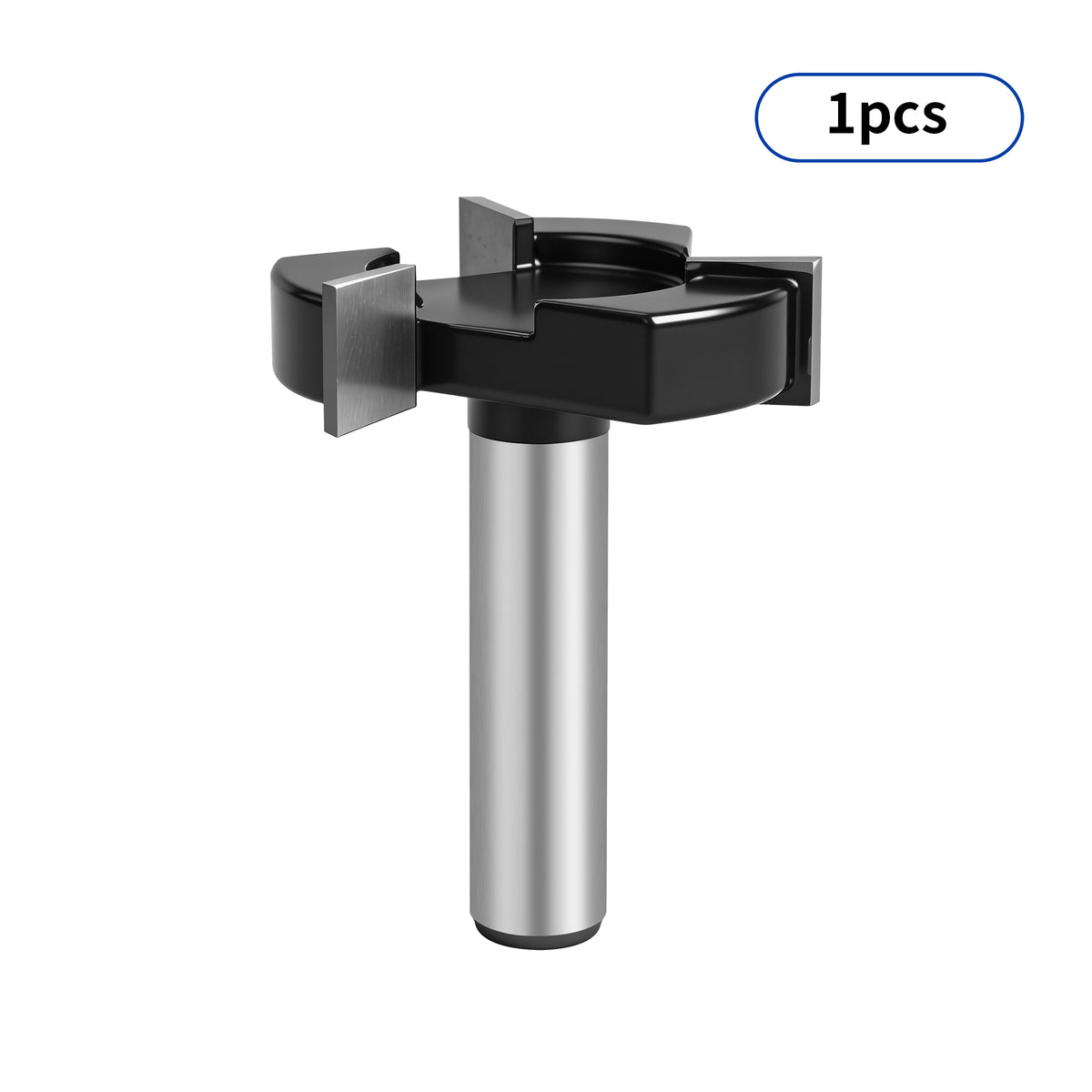
When comparing CNC router bits for wood, separate the head diameter, head height, neck clearance, shank diameter and usable reach. A suitable shank answers a holding question. It does not show that the head can enter the feature, pass the fixture, or cut the intended section within the machine and tool's limits.
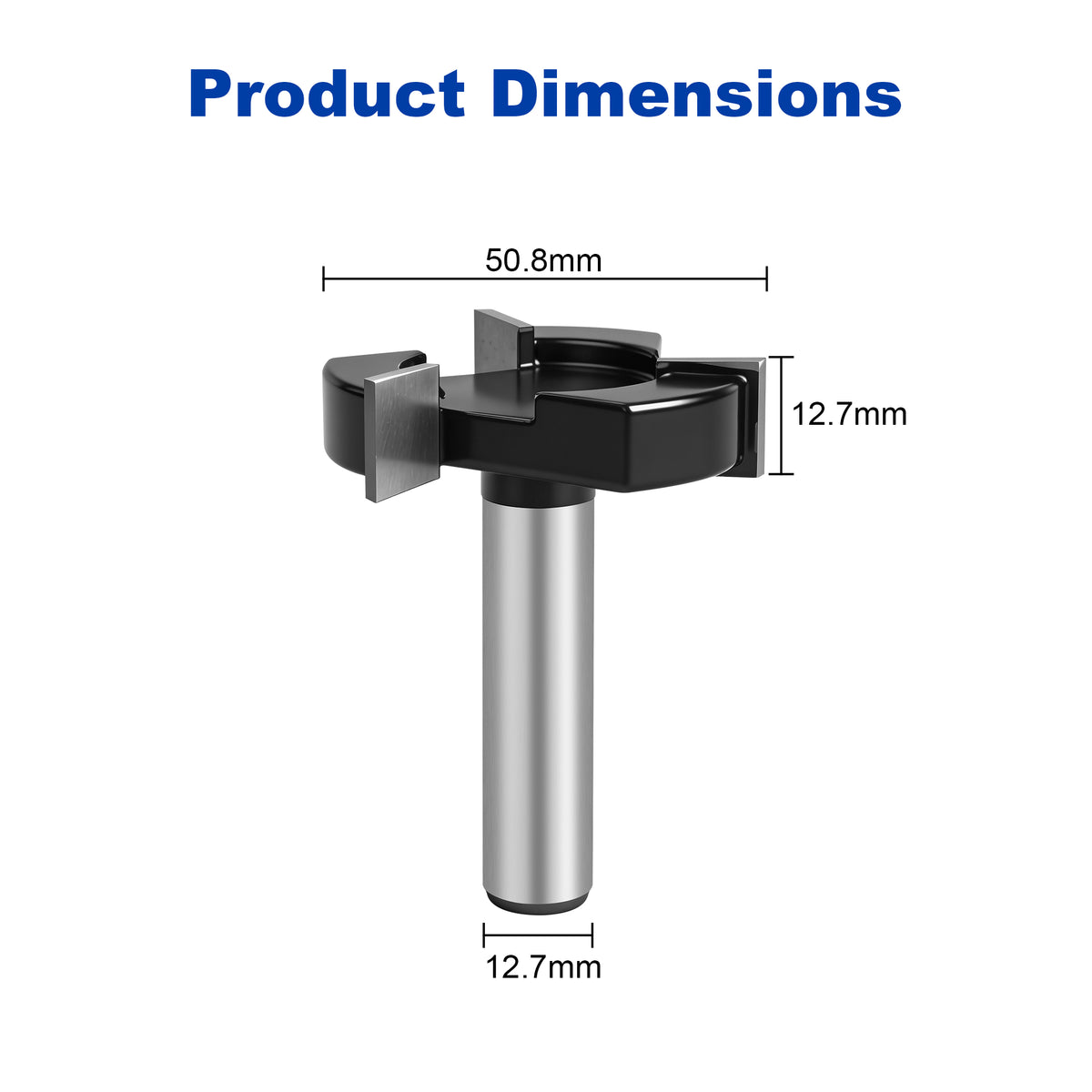
The TwoTrees dimension illustration labels a 50.8 mm head span, a 12.7 mm head height and a 12.7 mm shank. These are the manufacturer's illustrated dimensions, not measurements of a finished track. In particular, this is a substantial tool envelope to check before treating the product as an option for a desktop setup; do not infer fit from the general term CNC router.
Reach and clearance also involve a tradeoff. Harvey Performance's keyseat-cutter guidance explains that a thinner neck can provide greater clearance while reducing strength, and that longer reach increases susceptibility to deflection. That supports checking the complete tool geometry; it does not supply cutting data for the illustrated woodworking bit or justify extending a tool farther to force access.
Represent the actual cutter, holder, stock and fixture when planning the operation. Use the exact equipment instructions for permitted entry, speed, tool holding, guarding and extraction, and stop and isolate the machine as directed before handling the cutter. A woodworking CNC machine follows the programmed path, including any incorrectly modeled clearance.
For the movable stop, the useful choice is now concrete: retain the existing hardware and its required T-section, adopt the specified dovetail interface, or install an appropriate rail in its mounting recess. Once that interface and its service access are settled, select a cutter and manufacturing method that can produce it. The fixture's material and application limits remain part of its design, alongside the fit.


